11 SEP 2026 · SIMULATION / NEUROSCIENCE / PYTHON / NEUROMECHFLY / FLYWIRE
Can a fruit fly run a company better than I can?
I turned a fruit-fly brain model with 138,639 neurons into a company manager. Decisions, movement, and profitability with Brian2, NeuroMechFly, and MuJoCo.
64 simulated companies. 22 profitable year-ends. 34.4% profitability. The manager: a fruit-fly brain model.
After seeing fruit flies parallel park and make successful interest-rate decisions, I wanted to explore what else they could do. CEO (Chief Executive Organism) is a simulation modelled on a real fruit-fly brain.
The result first
I ran 64 company scenarios over one year. Each company had at most 12 decision opportunities, one per month. Decisions stopped when a company ran out of money and closed.
| Year-end outcome | Companies | Share of the original 64 |
|---|---|---|
| Profitable | 22 | 34.4% |
| Open but unprofitable | 30 | 46.9% |
| Closed | 12 | 18.8% |
Success here means ending the year with a profit. Having cash left is not enough: a company can remain open after spending some of its starting capital and still be unprofitable.
Among the 64 companies, company 4126 produced the highest annual profit: roughly $20,680 in profit and $40,394 in year-end cash.
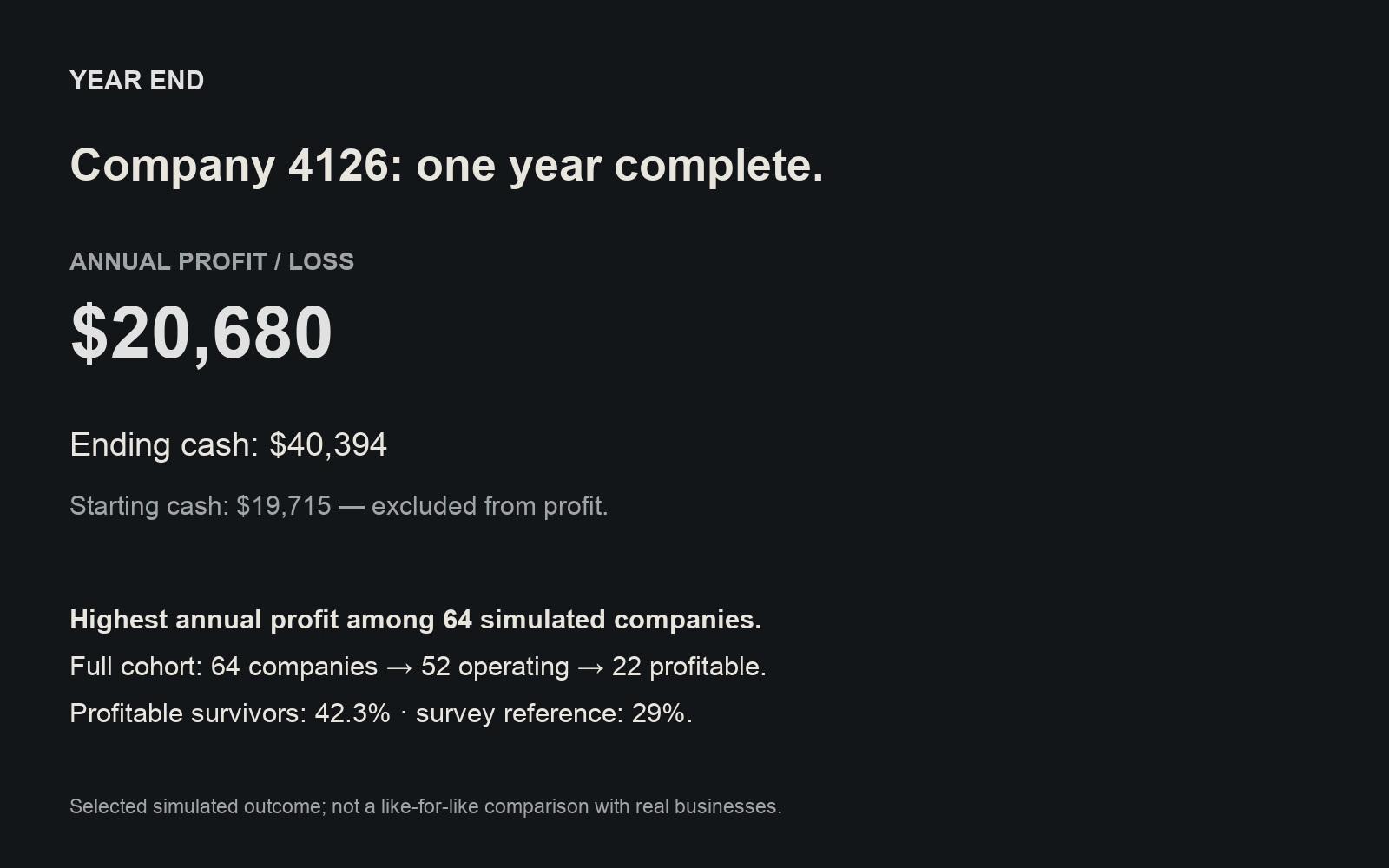
Among the 52 companies that remained open, profitability was 42.3%: 22/52. The headline result is 22/64 = 34.4%, which includes companies that closed.
What I used
| Layer | Tool | Role |
|---|---|---|
| Brain connectivity | FlyWire / FAFB v783 | Provide neurons and their connections |
| Brain dynamics | Shiu et al.’s Drosophila model, Brian2 | Calculate neural activity in response to stimulation |
| Company model | Python, NumPy | Update demand, costs, investments, and cash |
| Body and movement | NeuroMechFly / FlyGym, MuJoCo | Simulate the fly approaching its chosen object |
The brain model is not a language model. I did not prompt it to “act like a good CEO.” It computes neural activity across fixed connections; no financial learning or weight training happens during this experiment.
138,639 neurons, but no business knowledge
The FAFB v783 network I used contains 138,639 neurons and 15,091,983 directed connection records. The second number should not be read as a count of individual anatomical synapses; it is the number of records in the model’s connectivity table.
In Shiu’s leaky integrate-and-fire model, neuron states advance in time steps. Incoming effects accumulate; when a threshold is crossed, a neuron produces a spike. This does not reproduce the full biochemistry or behavioural repertoire of a real brain.
I ran Brian2 with the NumPy backend at a 0.1 ms time step. Each business decision computed 100 ms of neural-network activity. Neural state persisted between a company’s decisions and was reset between companies.
How does a company decision reach the neural network?
A fly has no concept of an “advertising budget.” I wrote a translation layer between business information and the neural network.
Five decision types were defined:
| Decision | Potential benefit | Cost or risk in the model |
|---|---|---|
| Hire | Add 30 units of capacity | $1,000 up-front cost and $900 additional monthly salary |
| Advertise | Increase demand in later months | $1,500 cost and uncertain customer response |
| Improve product | Increase demand through quality | $1,800 cost and a two-month delay |
| Raise price | Increase revenue per unit | $100 implementation cost and possible customer loss |
| Preserve cash | Make no new spend | Defer a growth opportunity |
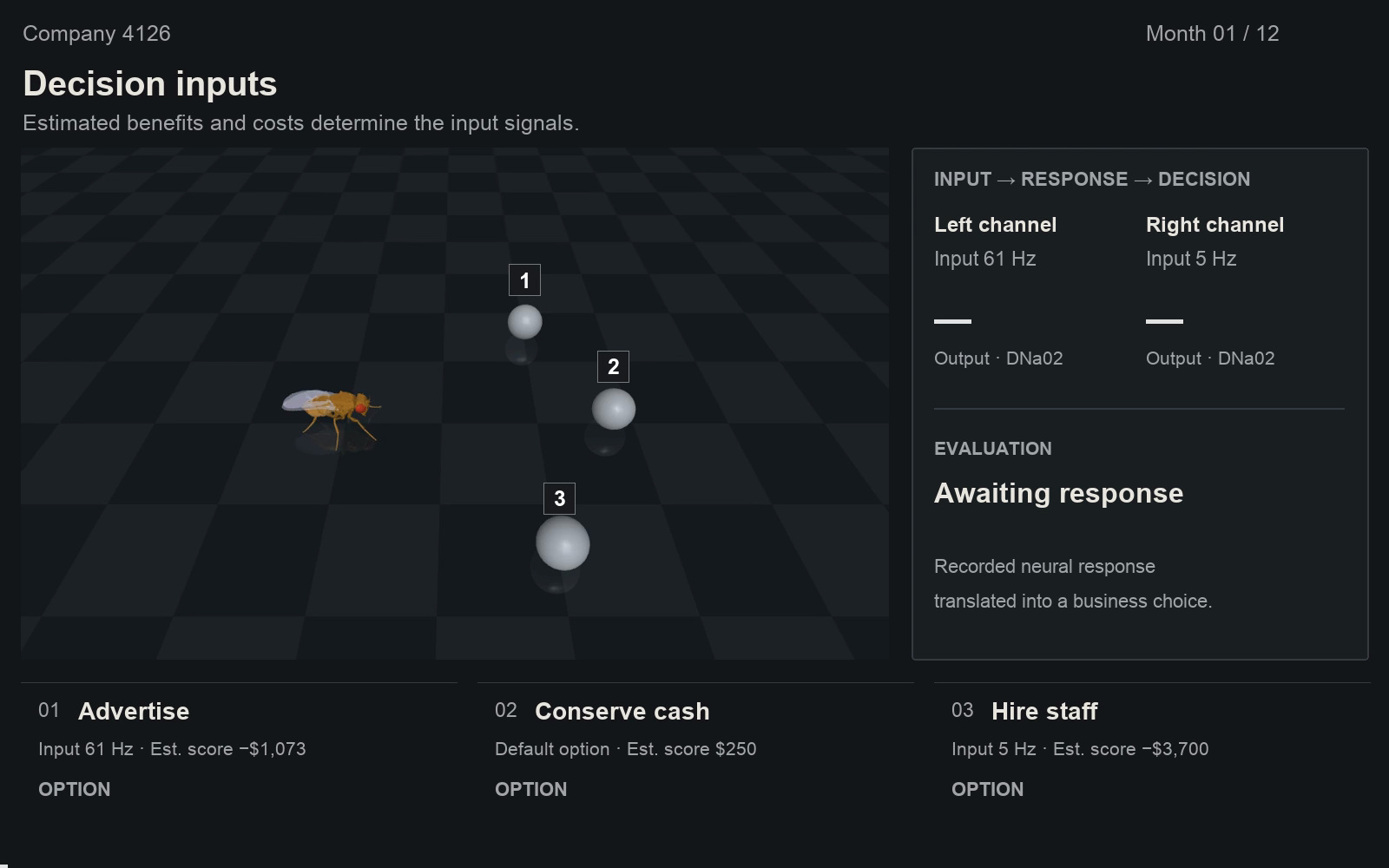
The fly does not see all five choices every month. Two investment options alternate, while “preserve cash” is always in the middle. Left and right positions vary by scenario.
The translation layer derives an approximate benefit and risk score for each option from current cash, capacity, and noisy demand/cost estimates. Costs weigh more as cash runs low:
cash_stress = 1 + max(0, 3 - cash / monthly_fixed_costs) / 3
score = estimated_benefit - cash_stress * estimated_downside
input_hz = clip(85 + score / 45, 5, 180)
The final line turns the options on the right and left into Poisson stimulation between 5 and 180 Hz. Five selected positive presynaptic inputs to the DNa02 target are stimulated on each side.
These scores do not know the future. Unseen cost shocks, the actual advertising response, and price elasticity are not exposed to the decision inputs. The liquidity premium in the “preserve cash” score is not real money invested in the company; it is part of the preference calculation.
That distinction matters: part of the economic intuition already lives in the scoring system I wrote. It would be wrong to attribute all success to the fly’s connectivity map.
From neural response to decision
I read the spike rates of two DNa02 targets at the output. The decision rule is simple:
if max(left_hz, right_hz) < 40 or abs(left_hz - right_hz) < 20:
    action = conserve_cash
elif left_hz > right_hz:
    action = left_option
else:
    action = right_option
Weak or closely matched outputs produce “preserve cash.” Otherwise, the option on the side with higher activity is applied. If cash or an investment limit is insufficient, the suggested investment also becomes “preserve cash.”
The decision chain is therefore:
Company state → estimated economic score → neural stimulation → neural response → business action.
I map the recorded neural responses to business choices. On its own, the model is not a brain that understands hiring or pricing.
What does the walk in the video show?
Once the business decision is computed, a virtual odour source is placed at the selected object’s position. Two virtual sensors near the head sample that source:
concentration = 100 / (1 + distance_squared)
The normalised difference between the left and right sensors determines the turn command for a hybrid walking controller. MuJoCo calculates the physical interaction between the legs and the ground.
The odour signal does not make the business decision; it makes an already-made decision visible through movement. I did not build a full bidirectional feedback loop between brain model and body. This demo is also not a direct reproduction of NeuroMechFly’s visual-tracking experiment.
I produced three physical approach recordings for the three option positions. Monthly decisions use the appropriate recording; different months in the video represent fresh brain decisions, not a new walking simulation from scratch for every month. NeuroMechFly project
The rules of the simulated economy
Companies begin with $9,000–$23,000 in cash, 90 units of capacity, and a $100 selling price. The monthly fixed cost is $3,600. Demand and unit costs change over time, and unexpected expenses can occur.
Demand is calculated roughly as follows:
demand = (
    base_demand * (1 + quality) + previous_advertising_stock
) * (100 / price) ** price_elasticity

units_sold = min(capacity, demand)
revenue = units_sold * price
net_result = revenue - operating_costs - decision_spending
cash += net_result
Advertising takes effect in the next month and decays monthly. Product improvements arrive two months later. Hiring adds a salary burden in later months. Choosing “preserve cash” does not stop rent or payroll.
When cash falls below zero, the company closes permanently. Annual profit is the sum of monthly net results. Since I expense all investment immediately, this is a simplified cash-based result rather than formal accounting profit.
Was the fly only lucky?
I also ran the same company and market scenarios with three alternatives: a financial rule that chooses the highest estimated score, random choice, and always preserving cash.
Each method sees the same starting state and pre-generated market events, so one method does not receive an easier economic year by chance.
| Decision method | Profitable / original companies | Profitability across all companies |
|---|---|---|
| Simple financial rule | 26 / 64 | 40.6% |
| Fly brain model | 22 / 64 | 34.4% |
| Always preserve cash | 17 / 64 | 26.6% |
| Random choice | 3 / 64 | 4.7% |
Under these conditions, the fly model beat random choice. The simple financial rule beat the fly. This experiment does not show that a biological connectivity map is the best decision-maker.
How does this compare with the real-world 29%?
In the Federal Reserve’s 2025 Firms in Focus report, 29% of firms with employees that were younger than two years reported a profit for the end of 2023. The group has 311 responses: 15% broke even and 55% reported a loss. Totals are 99% due to rounding. Source: Federal Reserve Small Business Credit Survey, 2025 Firms in Focus: Chartbook on Firms by Age of Business, p. 7
My 34.4% includes all 64 starting companies. The survey is not a cohort study that tracks every established company through closure. Economic conditions and definitions of profit also differ.
Reproducibility
The main experiment ran 64 scenarios, numbered 4100–4163. Market events, options, stimulation frequencies, neuron outputs, and each company’s before/after state were saved as JSON.
What interests me most is not declaring the fly a CEO, but seeing which interfaces can connect a biological connectivity map to an entirely different decision environment.
In short: the fly was not hired.